
Architecture
KOGENT is built around a three-layer model: skills execute locally, policy runs before every action, and cryptographic proof anchors everything to a verifiable identity.
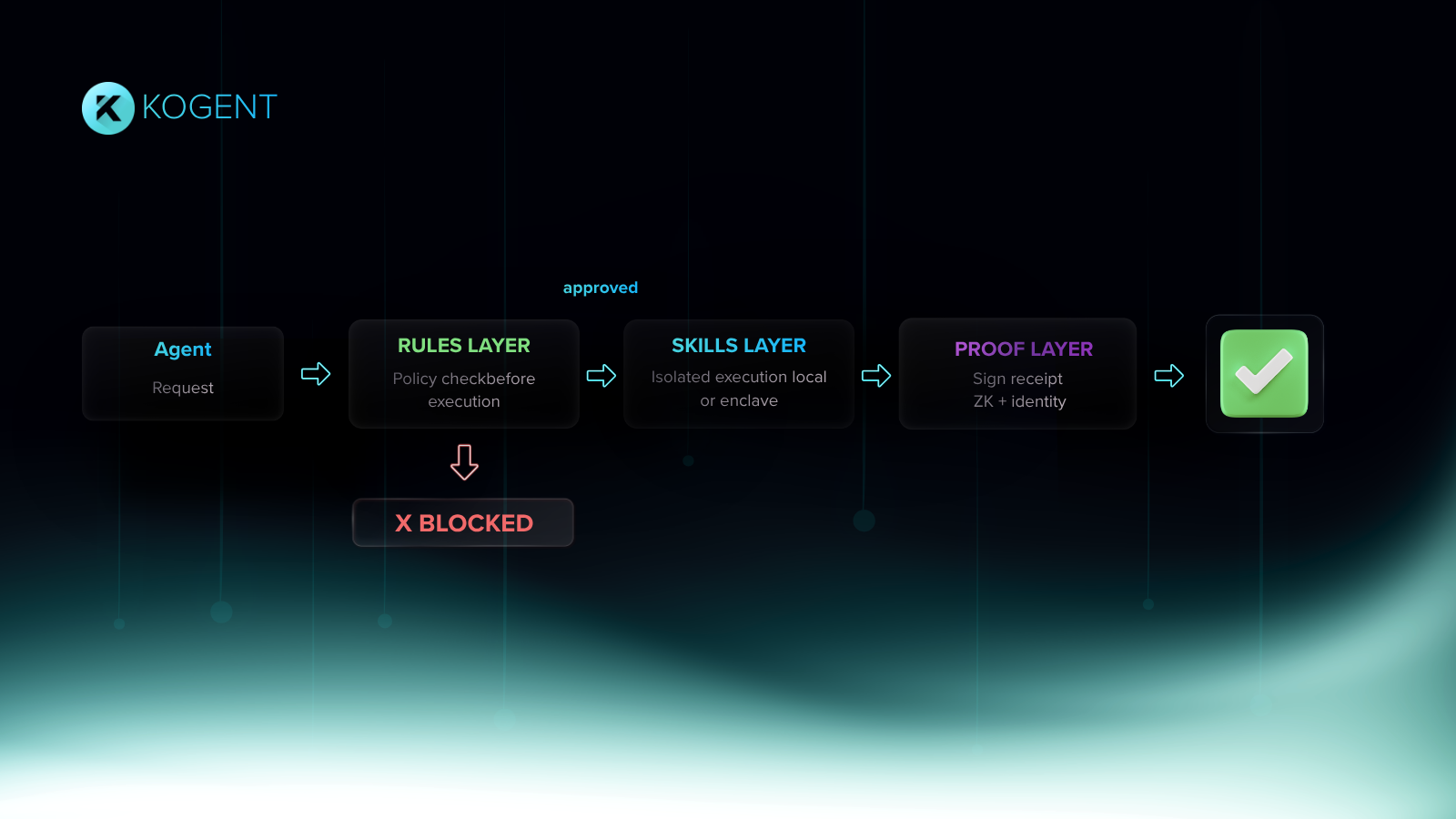
The three-layer model
- Skills layer. The agent calls a skill: Vigil, Sieve, Specter, or any of the others. The skill runs locally and returns a result. No external calls unless the skill explicitly requires them and declares them in
identity.json. - Rules layer. Before any action executes, the Rules skill evaluates it against active policy: spend limits, quiet hours, domain controls, and action-type restrictions. If the check fails, the action is blocked before anything happens.
- Proof layer. After execution, Verification issues a signed receipt. Specter generates a ZK commitment for payments. Identity anchors the agent to ERC-8004 on-chain. Everything is traceable back to a verifiable keypair.
Skill composition and chaining
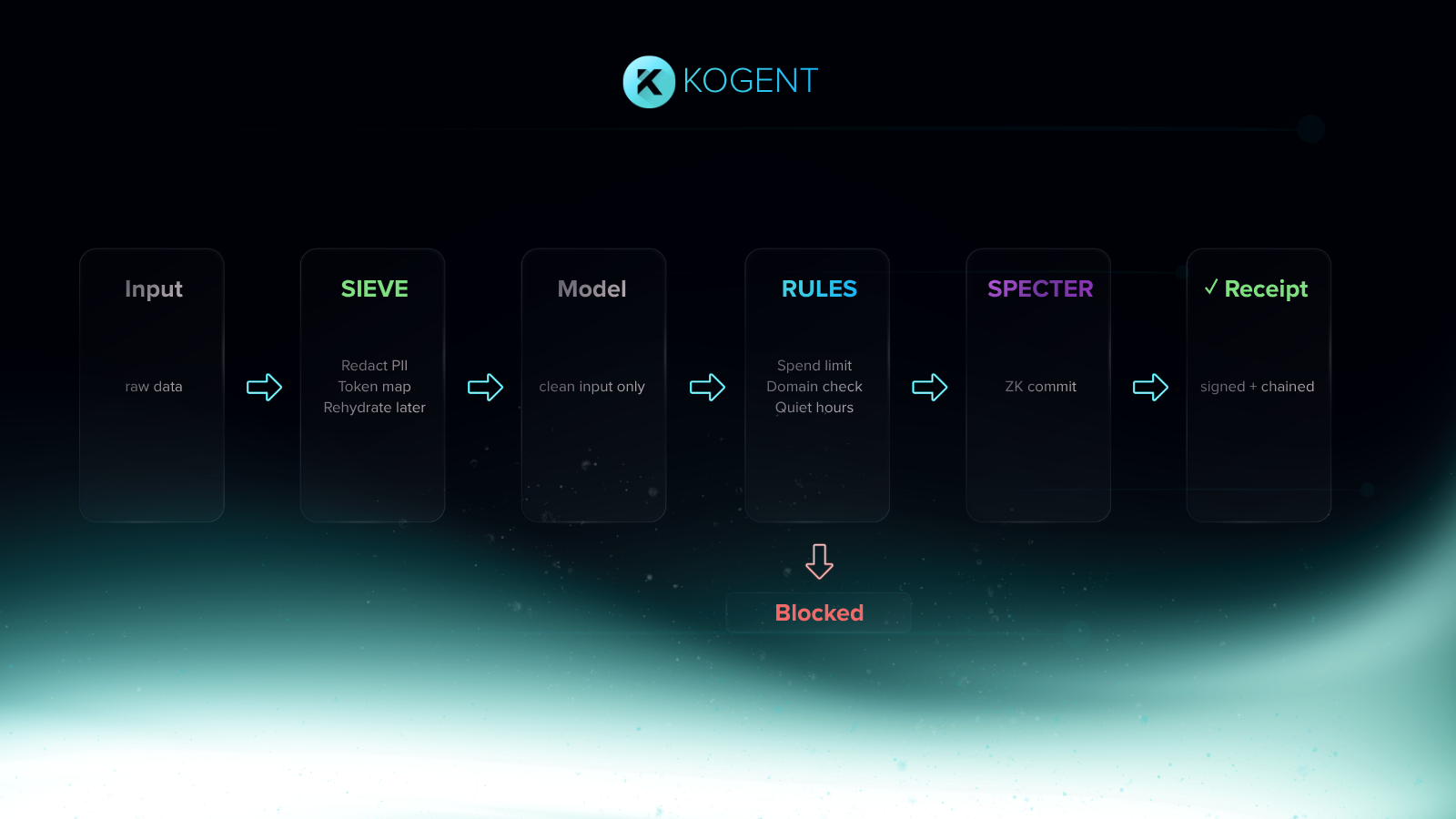
Skills compose. A single agent action typically activates several skills in sequence. For a document-processing task with a payment: Sieve redacts the raw input before it reaches the model, the model processes clean data, Rules validates the intended action against policy, Specter generates a ZK payment authorization, and Verification seals the outcome with a signed receipt.
Skills are stateless across calls. Persistent state (reputation scores, the nullifier registry, the receipt chain) is written to local storage by the skill on each call and read back on the next. No shared memory, no implicit coupling.
Deployment options
KOGENT runs in one of two modes:
- Local mode. All skills run on your machine. Receipts are signed locally. Calendar data, PII, and payment authorisations never leave the device. No external server is involved.
- Enclave mode. Skills run inside an isolated, encrypted virtual environment provisioned per user. No shared infrastructure, no plaintext data in transit, and no access by KOGENT to what runs inside. For users who cannot self-host but require the same privacy guarantees.
The only on-chain interactions in either mode are identity registration and payment commitments, and those are initiated explicitly, not automatically.